A useful summative assessment helps an educator explain what has changed in a child’s learning, what supports that interpretation and what the family and service might do next. The report gives that conversation something concrete to work from.
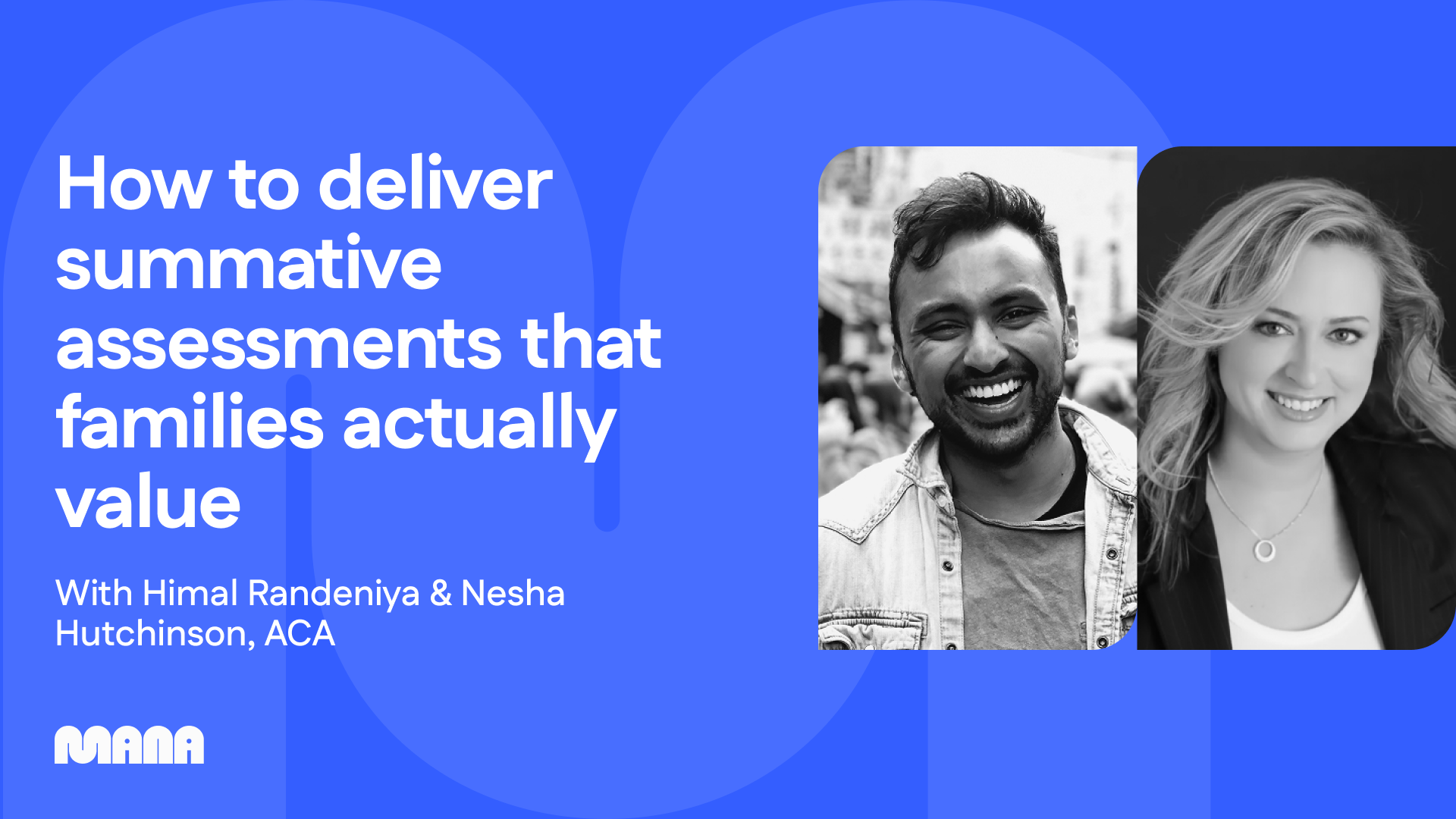
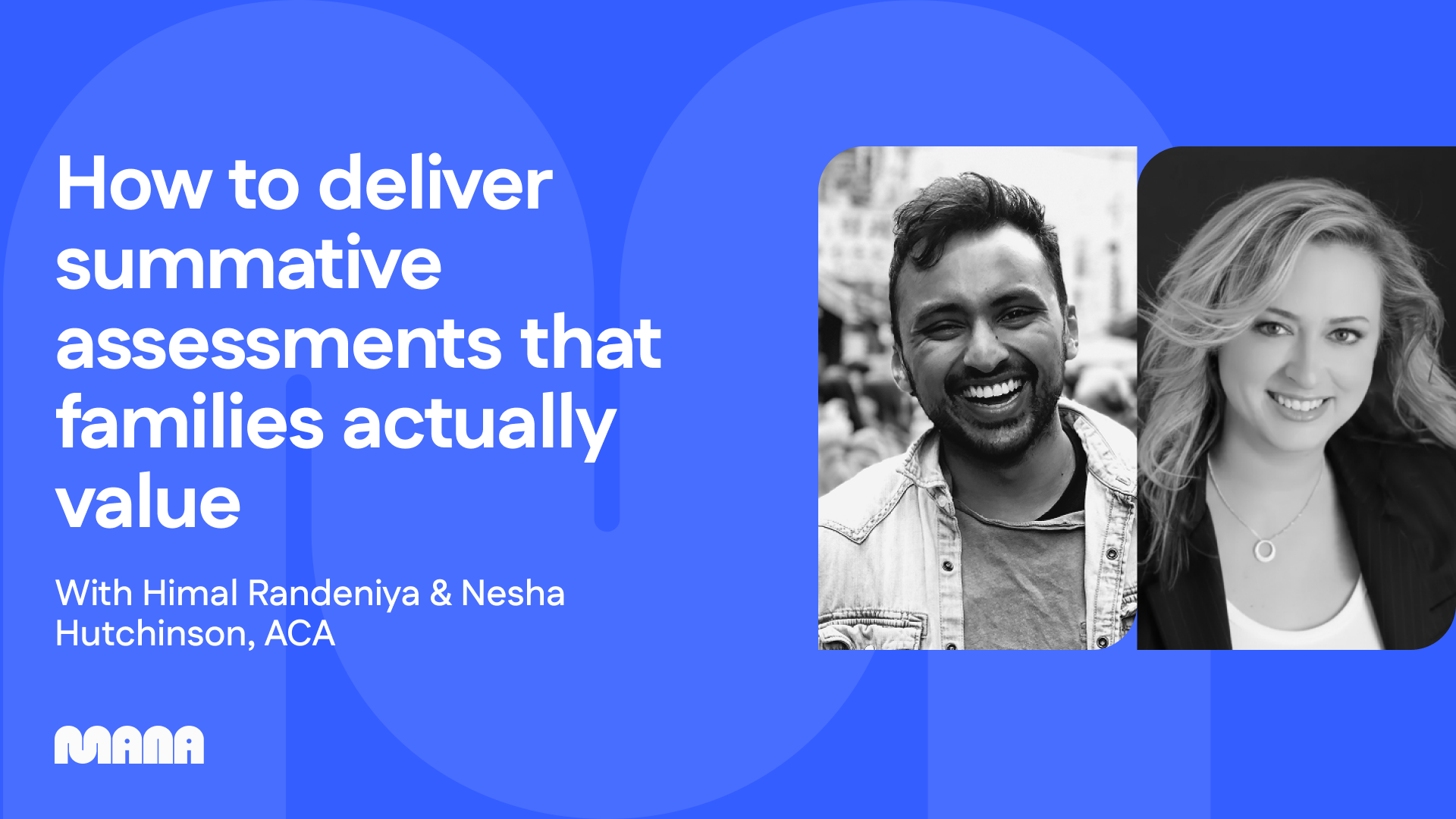
That was the central thread of Mana’s November 2025 webinar with Himal Randeniya and Nesha Hutchinson, hosted by Hayden Rolls. Their discussion brought assessment back to two connected purposes: thoughtful professional reflection and meaningful communication with families.
Look back so you can look forward
Himal distinguished assessment of learning from assessment for learning. A summative assessment looks back over a period to consider a child’s progress. A formative assessment uses what the educator understands to inform the next teaching response.
Those purposes can sit together in one family conversation. An educator can explain a change they have noticed, discuss what it might mean and invite the family’s perspective before deciding what follows.
A summary of completed activities leaves much of that reasoning out. Knowing that a child joined a construction experience tells a family where the child spent time. Explaining how the child began testing different ways to make a structure stable gives them something more useful to discuss.
That construction example is an editorial illustration, not a child record from the webinar. The principle is to make the learning and the educator’s interpretation visible.
Show that you know this child
Nesha’s advice began with the relationship. Families need to recognise their child in what the educator shares. Generic wording, a copied detail or an example that does not fit the child can quickly undermine the conversation.
Specific observations help. Describe what happened, when it happened and what changed across the period being considered. Explain the meaning in language the family can follow.
In the webinar, the speakers also discussed the different purposes of comparing a child’s progress with their earlier learning and considering broader developmental knowledge. They did not present every assessment method as interchangeable. Choosing an approach requires professional judgement about the question being asked and the child’s context.
For a family-facing summary, the useful question is how that judgement will be communicated. A document should help the family understand the child, with strengths and areas for support discussed carefully. A label or score without context does little of that work.
Invite the family into the interpretation
A family conversation gives educators access to knowledge they will not necessarily see at the service. It also gives families a clearer understanding of the learning that happens during play.
Himal described using these conversations to explain both the progress already observed and the learning priorities the team was considering. Nesha emphasised explaining how those priorities could be supported through play, including at home.
The conversation can begin with a few open questions:
- What have you noticed at home?
- Does this description fit what you are seeing?
- What matters to your child and family at the moment?
- Is there something we should understand before choosing a next step?
These are suggested discussion prompts drawn from the themes of the session. They are not a prescribed assessment format.
A useful next step should make sense to both the educator and the family. It might be a shared question to explore, a different invitation in the learning environment or a small opportunity to build on an interest at home.
Prepare educators for the conversation
A well-written assessment does not automatically make a difficult or technical conversation easy.
Himal described a gradual approach to building his teams’ confidence. Where educators needed support, a centre manager or educational leader led the conversations first. Room leaders and other educators became more involved through observation, practice and feedback.
His point was to match responsibility with capability and support. A service does not need every educator to begin in exactly the same place.
Nesha also suggested making the invitation clear. Families should know who will attend, what will be discussed and how much time has been set aside. Whether to send the assessment in advance depends partly on the relationship and how the information is likely to be understood.
When a concern goes beyond an educator’s expertise, the speakers encouraged seeking appropriate support and being clear about the limits of the educator’s role. Describing observations and discussing further support is different from making a diagnosis.
Let the format serve the purpose
The webinar explored different formats, including concise points linked to observations and a letter to the child. The shared emphasis was on reflection, evidence and communication.
For Australian NQF services, current ACECQA guidance explains that the National Law and Regulations do not prescribe a universal amount or method of educational documentation. Documentation needs to be understandable to educators and parents, with its use and the child’s circumstances considered. A service’s preferred reporting timetable should therefore be understood in its own context. Read ACECQA’s guidance on educational program documentation.
A useful review for your next assessment
Before sending the next report, read it as the beginning of a conversation:
- Can the family recognise their child in the examples?
- Is the interpretation supported by observations?
- Does the explanation make sense without specialist shorthand?
- Is there room for the family to add, question or change the picture?
- Does it help the educator decide what to do next?
For educational leaders, these questions can also guide a supportive discussion with the educator who prepared the assessment. The aim is to strengthen the connection between knowing the child, interpreting their learning and working with their family.
Watch the full webinar: How to deliver summative assessments that families actually value.
For an Australian example of connecting observation, interpretation and teaching, explore the worked EYLF planning cycle. For the Aotearoa New Zealand context, see the Te Whāriki assessment and planning example.