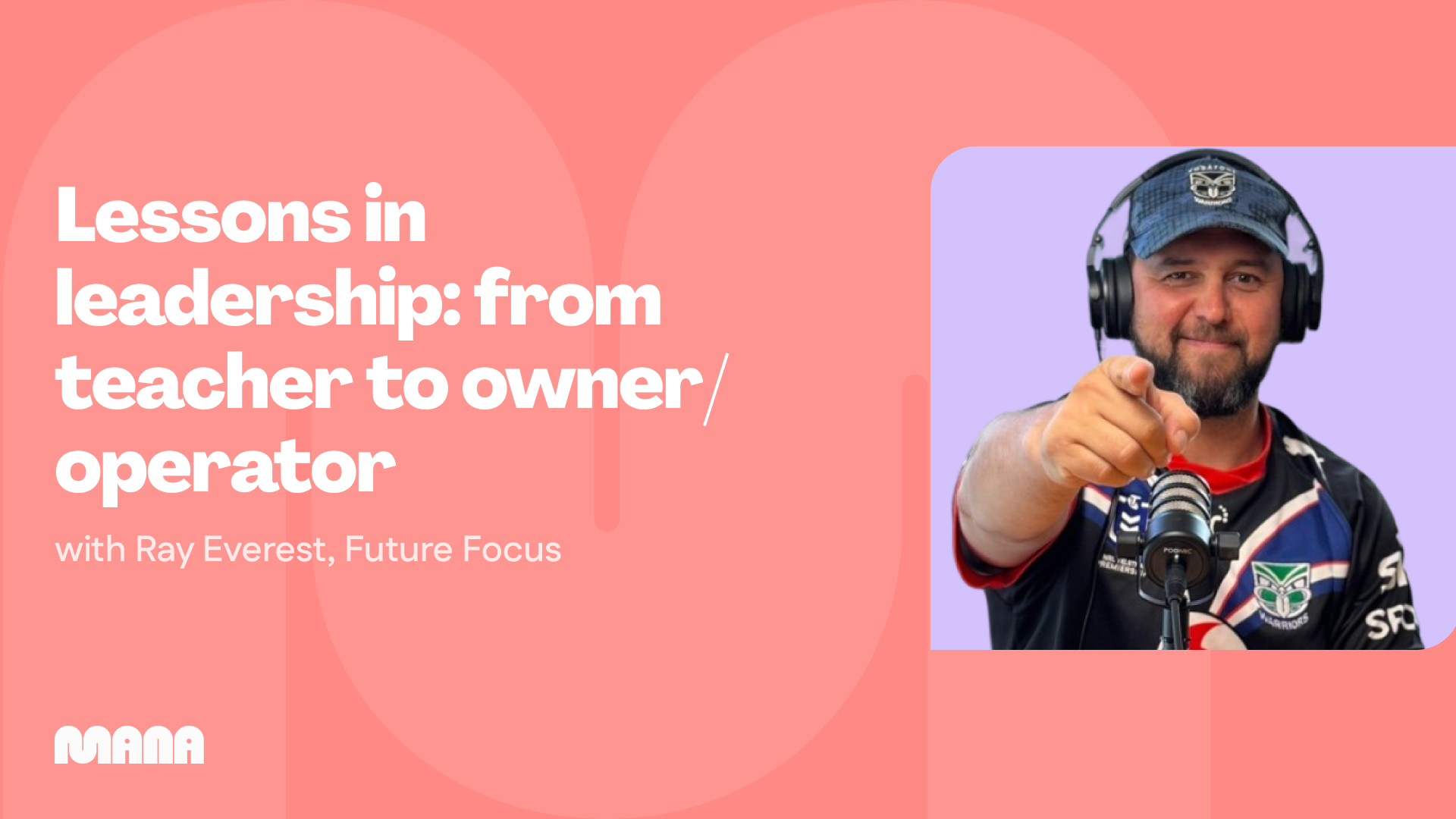
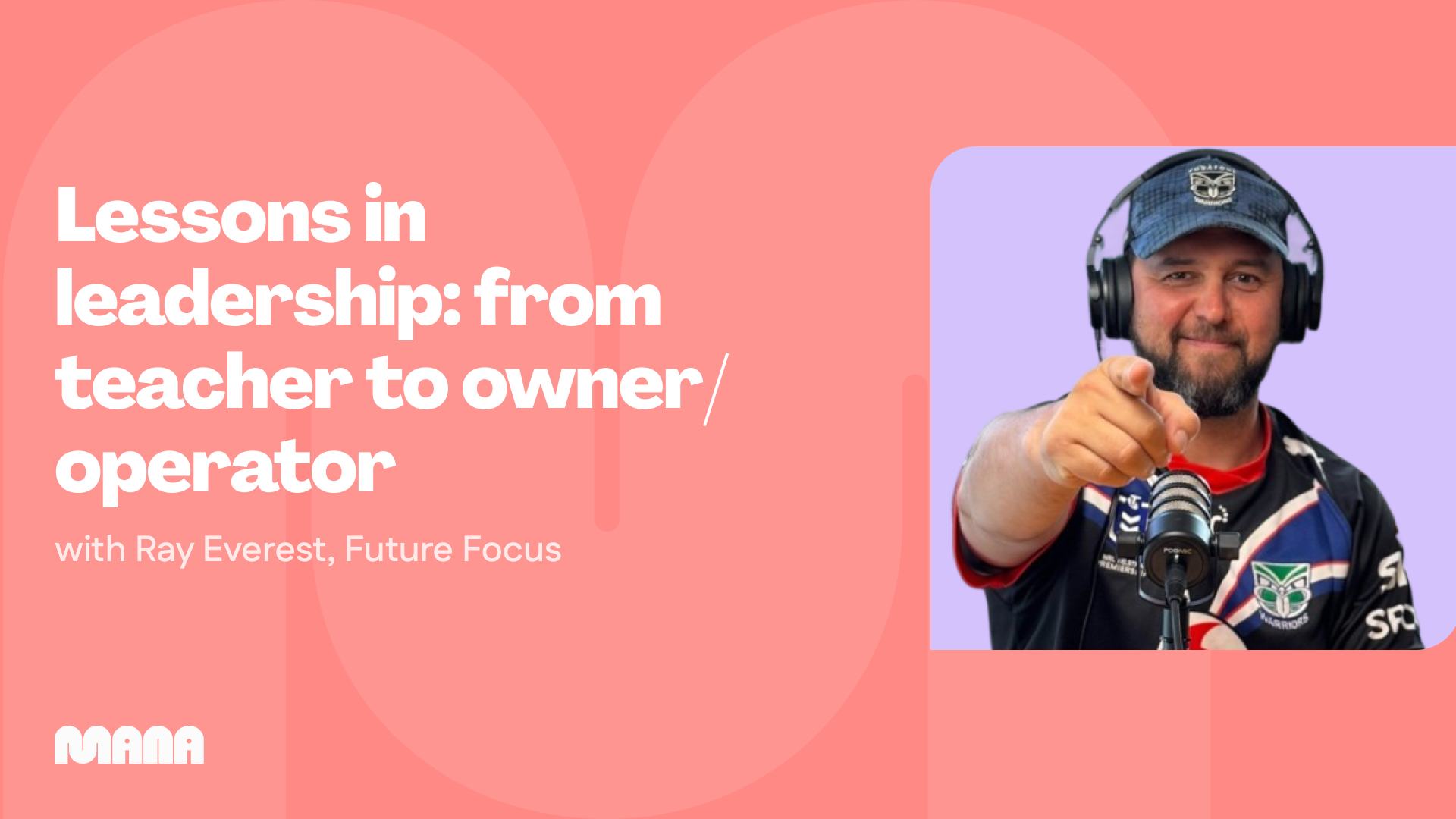
What changes when your role is to help other people do good work? For Ray Everest, one early answer arrived when a colleague told him that nobody could keep up with his pace.
He had ideas, energy and a strong sense of what he wanted to change. What he was still learning was how to bring people with him.
In Mana’s Lessons in Leadership: From Teacher to Owner/Operator, Ray joined Hayden Rolls to reflect on his journey through teaching, principalship and building Future Focus with Courtney in New Zealand. The conversation returned to a consistent idea: leadership creates opportunities for other people to think, contribute and grow.
That requires more than a compelling vision. It also requires attention to how people experience your everyday presence.
A strong vision still needs a workable pace
Ray described becoming a principal at 26 and asking his team what they would remove from their working day. His motivation was to reduce burdens so teachers could concentrate on teaching.
But wanting to help did not automatically make his pace helpful. He recalled an office manager explaining that the number of projects made it difficult for others to keep up. Looking back, Ray could see both the problem and something worth protecting: a colleague felt able to say it to him.
For a new leader, that is a useful question to carry into a change. Who can tell you that the plan is unclear, the workload is too large or the pace is wrong? What happens when they do?
Ray’s reflection does not suggest giving up ambition. It asks leaders to make enough room for others to understand and contribute to it.
Tell a story your team can see in practice
When Hayden asked how to bring people into change, Ray emphasised a compelling story and the need to follow through.
He described Future Focus’s commitment to telling stories about educators and learning. His shorthand was personal, relevant and timely: communication should mean something to the families receiving it, relate to their experience and connect with what is happening.
He also argued that leaders need to participate in the work they ask others to do. If educators are being invited to share their practice publicly, leaders should understand the vulnerability involved and model their own contribution.
The broader lesson is about alignment. A service’s story becomes more credible when families and educators can recognise it in everyday decisions. A vision for professional growth needs actual opportunities to learn. A commitment to listening needs places where people can speak and be heard.
Make room for the educator’s thinking
One of the most practical parts of the conversation concerned what happens when an educator brings a problem to a leader.
Ray described a phrase he tries to use: “I’ve got my own thoughts on this.” He then invites the other person to share their thinking first.
The opening communicates that support is available. The invitation creates room for the educator’s observations, ideas and judgement. It avoids making the conversation feel like a test in which the leader already holds the only acceptable answer.
Ray also acknowledged that questions can land differently depending on someone’s previous experience. Early in his ownership journey, a question from him could be heard as a threat simply because he was the owner. He learnt to explain his curiosity and ask for help understanding the situation.
That is a useful reminder to consider the relationship around a question, not just its wording. An invitation to think together needs to feel like one.
Return after the action
Ray called his developing approach “think, do, think”. He contrasted it with endless deliberation on one hand and constant activity without reflection on the other.
The final step is easy to lose in a busy service. A leader and educator discuss a challenge, agree something to try and move on. Without returning, neither knows much about what happened next.
Ray used a coaching example: giving someone a suggestion and walking away means missing whether it helped. Follow-through is part of the support.
For an early childhood leader, the return conversation can stay close to the work. What did you try? What did you notice? What changed, and what still needs attention? The point is to learn from the action together, rather than simply record that advice was given.
Ray also made a clear exception. When someone has experienced violence, abuse or an immediate distressing incident, an open-ended coaching question is not the first response. Direct support and action come first. His approach was not intended as a universal script for every situation.
Create places where leaders can ask for help
Ray described Future Focus’s regular leadership councils as a place for leaders to talk through the work. The significance was the opportunity to admit uncertainty and learn with others.
He challenged the idea that a leader must always be the main source of knowledge. Facilitating another person’s thinking can be part of the role, alongside offering experience and making decisions when needed.
For a team, the useful question is where those conversations happen now. Is support dependent on catching one busy person at the right moment, or is there a dependable opportunity to reflect and work through a challenge?
The meeting format can vary. What matters in Ray’s account is access to the conversation and a commitment to return to the work.
Notice when stepping back helps
Ray said some of his strongest lessons came after stepping away from the day-to-day role. He became more aware that a founder’s suggestion can feel like an instruction, and that an enjoyable conversation with him could still take an hour from someone’s day.
He described becoming more deliberate about arranging a time to visit rather than assuming his presence was always helpful.
That reflection brings the conversation back to its starting point. Leadership is not measured only by how much energy you bring or how many answers you offer. It also involves noticing the space you leave for other people to lead.